Boom Lift Safety: OSHA Regs, Training & Penalties
Up to $165,514/violation for willful OSHA boom lift violations. Covers 1926.453 vs 1910.67, harness rules, power line clearance & training requirements.
By Ray Smith · Published March 24, 2026 · Last updated May 27, 2026

Find Aerial Lifts & Boom Lifts Rental Near You
472 companies across 33 cities
Quick Reference
Disclaimer: This guide is for informational purposes only and does not constitute legal or safety compliance advice. Regulations and standards are subject to change. Always consult the current OSHA regulations at osha.gov, your equipment manufacturer’s operator manual, and a qualified safety professional before operating any aerial lift. Your employer is responsible for ensuring compliance with all applicable federal, state, and local regulations.
Who This Guide Is For
If you’re a construction site supervisor, safety manager, contractor, or operator who needs to understand what OSHA actually requires for boom lift operation, this guide breaks it down.
It follows the two primary federal standards: 29 CFR 1926.453 (construction) and 29 CFR 1910.67 (general industry), plus the updated ANSI A92 framework, training requirements, fall protection, pre-operation inspection, and OSHA penalty exposure. Read it as a reference — then go to the primary regulations and your equipment’s operator manual before putting anyone in a basket.
For guidance on choosing and renting a boom lift, see the companion aerial lift rental guide.
OSHA Standards That Apply to Boom Lifts
Two OSHA standards govern aerial lift operation depending on your industry.
Construction: 29 CFR 1926.453
If you’re in construction, 29 CFR 1926.453 is your standard. It covers extensible boom platforms, aerial ladders, articulating boom platforms, vertical towers, and combinations of these devices. You’ll find requirements for training, fall protection, pre-operation controls, load limits, ground setup, and equipment modifications.
The standard requires that aerial lifts acquired on or after January 22, 1973 be designed and constructed in conformance with ANSI A92.2-1969 requirements. Field modifications are permitted only when certified in writing by the manufacturer or an equivalent entity such as a nationally recognized testing laboratory. Modifying a lift without that written certification is a direct violation of 1926.453.
General Industry: 29 CFR 1910.67
If you’re in manufacturing, warehousing, facilities maintenance, or another general industry setting, your standard is 29 CFR 1910.67. The core safety requirements mirror 1926.453, but the fall protection PPE requirements reference different subparts. Don’t assume the construction standard applies to your situation — consult 1910.67 and the subpart I PPE requirements it references.
Not sure which standard applies? Talk to a qualified safety professional or contact your OSHA regional office.
ANSI A92 Standards: The New MEWP Framework
OSHA regulations reference ANSI standards, but they don’t automatically update when ANSI revises them. The standard cited in 1926.453 is still ANSI A92.2-1969. Meanwhile, the ANSI A92 committee has issued a major update that equipment manufacturers and safety programs are increasingly adopting.
The new ANSI standards are organized by subject: A92.20 covers design, A92.22 covers safe use, and A92.24 covers training. They apply across booms, scissors, and manually propelled aerials. You’ll also notice new terminology — “AWP” (Aerial Work Platform) is now “MEWP” (Mobile Elevating Work Platform) in manufacturer docs and training programs.
Under ANSI A92.20, equipment manufactured to the new standard must include two significant safety technologies:
- Active platform load sensing: The machine must continuously check the weight in the platform and automatically disable functions if the load exceeds the platform load limit.
- Dynamic terrain sensing for booms: Drive and certain boom functions must be disabled when the machine is outside its rated slope limit, with only those functions available that safely return the machine to terrain within limits.
Under ANSI A92.22, employers (referred to as “users”) are required to develop a comprehensive MEWP-specific safe-use program, per the IPAF guide on developing such programs. This goes beyond basic training — it encompasses inspection, maintenance, repair, and safe operation procedures documented at the organizational level.
How the old OSHA-referenced ANSI versions interact with the current A92 framework isn’t straightforward — get qualified guidance on this. Equipment built to the newer standards will have different capabilities and controls than older machines built to A92.2-1969.
Operator Training and Certification Requirements
Who Is Permitted to Operate a Boom Lift
29 CFR 1926.453 states plainly: “Only authorized persons shall operate an aerial lift.” 29 CFR 1910.67 uses equivalent language for general industry: “Only trained persons shall operate an aerial lift.”
There’s no government-issued operator license. The employer is responsible for making sure anyone who operates a boom lift has been properly trained before they touch the controls.
What Training Must Cover
Per OSHA’s aerial lifts eTool, training must include:
- Explanations of electrical, fall, struck-by, and falling object hazards
- Procedures for dealing with those hazards
- Recognizing and avoiding unsafe conditions in the work setting
- Instructions for correct operation of the lift, including maximum intended load and load capacity
- Demonstrations of the skills and knowledge needed to operate the specific aerial lift before using it on the job
- When and how to perform inspections
- Manufacturer’s requirements for the equipment
Training must be specific to the type of lift the worker will operate. Scissor lift training doesn’t count for boom lift operation.
When Retraining Is Required
This trips people up. OSHA doesn’t mandate training renewal on a fixed schedule. There’s no required annual refresher, no three-year recertification, no five-year renewal under 29 CFR 1926.453 or 1910.67.
Retraining is required when any of the following events occur:
- An incident occurs during aerial lift use
- Workplace hazards involving an aerial lift are discovered
- A different type of aerial lift is to be used
- An employer observes a worker operating the equipment improperly
If none of these events apply, the original training stands. Many employers run calendar-based refreshers as company policy, and that’s a smart practice, but it’s not what OSHA requires. Know the difference when you’re assessing your compliance exposure.
Need a boom lift for your project? Many independent rental companies offer operator orientation or can connect you with certified training providers. Browse aerial lift rental companies near you.
Fall Protection Requirements
Construction Standard Requirements
29 CFR 1926.453 requires that a body belt be worn and a lanyard attached to the boom or basket when working from an aerial lift.
Here’s the catch. Since January 1, 1998, body belts aren’t acceptable as part of a personal fall arrest system under subpart M (29 CFR 1926.502(d)). They’re still allowed in a tethering or restraint system. In practice, that means a body belt with a lanyard clipped to the basket anchor point works as a restraint — it keeps the operator from getting thrown out, but it won’t arrest a free fall. Most employers and general contractors go further and require full-body harnesses on all boom lifts.
The regulation also prohibits belting off to an adjacent pole, structure, or equipment. Your lanyard attaches to the boom or basket — not to whatever happens to be nearby.
Stand on the floor of the basket. Don’t sit on the edge, climb the guardrails, or stack planks or ladders for extra height. And don’t wear climbers (lineman’s spikes or gaffs) while working from an aerial lift.
General Industry Standard Requirements
29 CFR 1910.67 requires a personal fall arrest or travel restraint system meeting the requirements in subpart I of that part, worn and attached to the boom or basket when working from an aerial lift.
Boom Lift vs Scissor Lift Fall Protection
| Requirement | Boom Lift | Scissor Lift |
|---|---|---|
| Harness required by OSHA? | Yes — body belt/harness with lanyard attached to boom or basket | No — guardrails are sufficient if intact |
| When fall protection applies | At all times in the basket, including transit | When guardrails are removed or inadequate |
| Anchor point | Manufacturer’s designated point on boom or basket | N/A (guardrail system) |
| Body belt allowed? | Restraint only — not for fall arrest (since Jan 1, 1998) | N/A |
| Common jobsite practice | Full-body harness required by most GCs | Many GCs require harness regardless of OSHA minimum |
Fall Protection During Transit
An OSHA letter of interpretation makes this clear: fall protection must be worn at all times in the bucket, including when moving between work locations. It’s not a “raised platform” requirement — it applies the moment someone steps into the basket.
For a broader comparison of aerial lift options and their fall protection considerations, see the aerial lift rental guide.
Pre-Operation Inspection Checklist
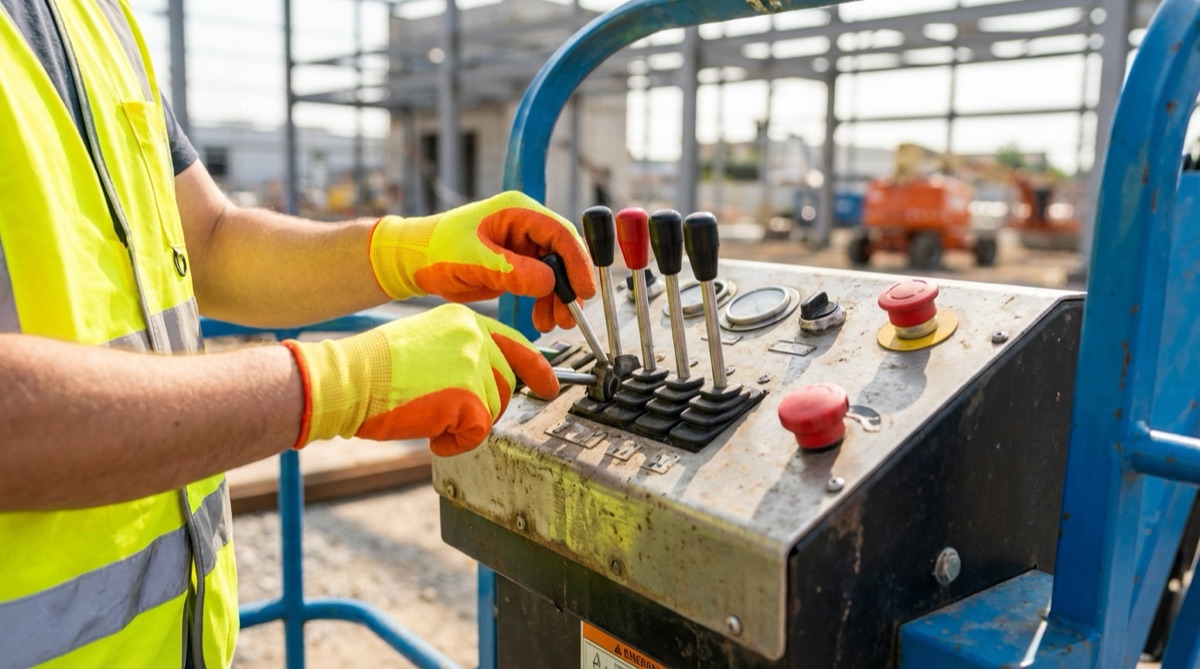
29 CFR 1926.453 requires that lift controls be tested each day prior to use to confirm they are in safe working condition. The OSHA aerial lifts eTool expands this into three inspection categories.
Vehicle Components
Before each shift, inspect:
- Proper fluid levels: oil, hydraulic fluid, fuel, and coolant
- Leaks of any fluids
- Wheels and tires
- Battery and charger condition
- Lower-level controls
- Horn, gauges, lights, and backup alarms
- Steering and brakes
Lift Components
Inspect:
- Operating and emergency controls
- Personal protective devices
- Hydraulic, air, pneumatic, fuel, and electrical systems
- Fiberglass and other insulating components
- Placards, warnings, and operational and instructional markings — flag anything missing or unreadable
- Mechanical fasteners and locking pins
- Cable and wiring harnesses
- Outriggers, stabilizers, and other structural components
- Loose or missing parts
- Guardrail systems
Work Area
Survey the work area before raising the platform:
- Drop-offs, holes, or unstable surfaces including loose dirt
- Inadequate ceiling heights for the boom’s range of motion
- Slopes, ditches, or bumps that could affect stability
- Debris and floor obstructions on the travel path
- Overhead electric power lines and communication cables
- Other overhead obstructions (beams, pipes, sprinkler heads)
- Hazardous locations and atmospheres
- High wind and other severe weather, including ice
- The presence and proximity of other workers
Don’t delegate the work area check to someone who won’t be operating the lift. The operator needs to understand the site conditions before the first movement.
Load Capacity and Weight Limits
29 CFR 1926.453 puts it simply: “Boom and basket load limits specified by the manufacturer shall not be exceeded.” There’s no single regulatory number — the limit is whatever the manufacturer set for your specific machine. It’s a hard ceiling.
When you’re calculating load, account for the combined weight of everyone in the basket, plus tools, plus materials. Per OSHA guidance, that combined weight must stay within the platform load limit.
Newer equipment built to ANSI A92.20 will actively disable functions when the platform is overloaded. Older equipment won’t warn you. Either way, check the rated capacity placard before loading the basket.
Don’t use the aerial lift as a crane or to hoist materials. Boom lifts aren’t rigging equipment and aren’t designed for the forces that come with hoisting loads below the platform.
Weather and Wind Speed Limits
OSHA guidance is straightforward: don’t operate an aerial lift in wind speeds above the manufacturer’s recommendation. OSHA doesn’t set a universal wind speed number — the limit is whatever the manufacturer rated your specific machine for.
For reference, Genie sets a 28 mph (12.5 m/s) wind speed limit on certain boom lift models. Other manufacturers may set different thresholds. The authoritative source is always the operator manual for the machine on your site.
Don’t assume one wind speed limit applies to all boom lifts. Check the manual.
And here’s what catches people off guard: operating above the manufacturer’s rating is an OSHA violation even though no specific wind speed appears in the CFR. The regulation incorporates manufacturer requirements by reference.
Electrical Hazards and Power Line Clearance
Contact with overhead power lines kills boom lift operators. The OSHA aerial lifts eTool requires treating all overhead lines and communication cables as energized and staying at least 10 feet (3 meters) away. That clearance applies to the platform, the boom arm, and anything conductive the operator is holding.
One thing people get wrong: an insulated aerial lift protects you by isolating you from ground. But it won’t protect you if there’s another path to ground — for instance, if you contact a second energized conductor at the same time. Insulation isn’t a substitute for clearance.
29 CFR 1926.453 further specifies that the insulated portion of an aerial lift shall not be altered in any manner that might reduce its insulating value. Painting over insulated components, attaching non-insulating materials, or modifying the dielectric sections of the boom are prohibited.
For work that will consistently involve proximity to energized lines, consult a qualified electrical safety professional and your utility company before beginning operations. The 10-foot minimum clearance is a floor, not a target.
Ground Conditions and Setup Requirements
Ground setup isn’t optional. 29 CFR 1926.453 specifies:
- Brakes shall be set before any elevated work begins
- When outriggers are used, they shall be positioned on pads or a solid surface — not on soft ground or over voids
- Wheel chocks shall be installed before using an aerial lift on an incline, where they can be safely installed
Before moving the lift for travel (repositioning to a new area), the boom must be inspected to confirm it is properly cradled and outriggers are in the stowed position. Moving an aerial lift with an unsecured boom is a stability hazard and a regulatory violation.
Don’t move an aerial lift truck with the boom elevated and people in the basket unless the equipment is specifically designed for it. Self-propelled boom lifts that allow travel while elevated will say so in their specs and operator manual. If it doesn’t say it can, the boom comes down before the machine moves.
Articulating and extensible boom platforms must have both upper (platform) controls and lower controls. The lower controls must be capable of overriding the upper controls for emergency use. Verify this dual-control function during the pre-operation inspection.
For comparison with alternative elevated access methods where ground conditions may be an issue, see the scaffolding and ladder rental guide.
OSHA Penalties for Non-Compliance
OSHA adjusts penalty amounts every year for inflation. The figures below reflect the 2025 adjustment and will change in future years. Check osha.gov for current amounts.
| Violation Type | Minimum | Maximum |
|---|---|---|
| Serious | $1,221 per violation | $16,550 per violation |
| Willful or Repeated | $11,823 per violation | $165,514 per violation |
| Failure to Abate | — | $16,550 per day (generally limited to 30 days maximum) |
A Serious violation means the employer knew or should have known about the hazard, and it could cause serious harm or death. Missing fall protection, untrained operators, exceeded load limits — OSHA cites these regularly.
Willful means intentional disregard or plain indifference to employee safety. Repeated violations (same citation on subsequent inspections) carry the same penalty tier. These add up fast.
Failure to Abate kicks in when you don’t correct a cited violation by the deadline. The daily penalty runs until the hazard is fixed.
A single inspection that turns up boom lift safety gaps can generate multiple Serious citations. On an active construction site, that’s real financial exposure.
For context on forklift safety penalty exposure, which follows a similar structure, see the forklift rental guide.
Find a Rental Company Near You
Looking for a boom lift for your next project? Browse local independent rental companies through our aerial lifts directory. These are companies you can call directly and talk to someone who actually knows the equipment.
Ready to Rent? Find Aerial Lifts & Boom Lifts Companies Near You
472 companies across 33 cities
Sources
- OSHA — 29 CFR 1926.453 Aerial Lifts (Construction)
- OSHA — 29 CFR 1910.67 Vehicle-Mounted Elevating and Rotating Work Platforms (General Industry)
- OSHA eTool — Aerial Lifts Safety
- OSHA — Letter of Interpretation: Fall Protection During Aerial Lift Transit (2000-01-06)
- OSHA — 2025 Annual Adjustments to OSHA Civil Penalties
- Genie Lift — ANSI A92 Standards Overview
- IPAF — Developing a MEWP Safe-Use Program Guide
About the Author
Founder
Ray Smith built EquipNearby to help contractors and project managers find independent equipment rental companies across the US East Coast.
Frequently Asked Questions
Is there a specific certification or license required to operate a boom lift?
No government-issued license exists for boom lift operation. OSHA requires that only authorized persons (construction, 29 CFR 1926.453) or trained persons (general industry, 29 CFR 1910.67) operate an aerial lift. Employers must provide and document training covering hazard recognition, equipment inspection, safe operation, and fall protection for the specific lift type. OSHA does not mandate a specific certification body.
How often does boom lift training need to be renewed?
OSHA does not set a fixed renewal period. There is no mandatory 3-year or 5-year retraining cycle. Retraining is required only when a triggering event occurs: an incident during aerial lift use, discovery of new workplace hazards, use of a different lift type, or an employer observing improper operation. If none of these events occur, the original training remains valid. The OSHA requirement is event-based, not calendar-based.
Do boom lift operators need to wear a harness?
Yes. OSHA 29 CFR 1926.453 requires that a body belt be worn with a lanyard attached to the boom or basket when working from an aerial lift. Since January 1, 1998, body belts cannot be used as part of a personal fall arrest system — they are permitted only as tethering or restraint systems. General industry (29 CFR 1910.67) requires a personal fall arrest or travel restraint system meeting subpart I requirements. Many employers and general contractors require a full-body harness on all boom lifts. Fall protection must be worn at all times, including when moving between work locations.
What is the minimum clearance required from overhead power lines?
OSHA requires at least 10 feet (3 meters) of clearance from all overhead power lines and communication cables. All lines must be treated as energized regardless of appearance. This clearance applies to the platform, the boom, and any conductive objects held by the operator. Insulated aerial lifts isolate you from ground but won't protect against contact with a second energized conductor. For lines above standard distribution voltage, consult a qualified electrical safety professional.
Can a boom lift be used as a crane to hoist materials?
No. OSHA guidance explicitly states that an aerial lift shall not be used as a crane or to hoist materials. Boom lifts are designed to elevate personnel, not to serve as rigging or material hoisting equipment. Using one as a crane can overload the structure, compromise stability, and create citation exposure. For material hoisting, use equipment designed for that purpose.
What are the OSHA penalties for boom lift violations?
Under the 2025 annual penalty adjustment, OSHA can issue fines of up to $16,550 per violation for Serious violations. Willful or Repeated violations carry penalties up to $165,514 per violation, with a minimum of $11,823 per violation. Failure to Abate penalties run $16,550 per day past the abatement date, generally capped at 30 days. These figures are adjusted annually for inflation under the Federal Civil Penalties Inflation Adjustment Act Improvements Act of 2015 and will change in future years.
What is the difference between OSHA 1926.453 and OSHA 1910.67?
Both standards cover aerial lifts, but they apply to different industries. 29 CFR 1926.453 applies to the construction industry. 29 CFR 1910.67 applies to general industry workplaces such as manufacturing, warehousing, and maintenance. The core safety requirements are similar, but there are differences in how fall protection is described and which subparts apply for ancillary requirements like PPE. If your work is construction, 1926.453 is your primary standard. For general industry, it is 1910.67.
Aerial Lifts & Boom Lifts Rental Companies by State
Browse 472 companies across 27 states.
Where to Find Aerial Lifts & Boom Lifts Rentals
We list 472 companies renting aerial lifts & boom lifts across 33 cities. Browse by city to find rental companies near you.
Related Rental Guides
Aerial Lift Rental Guide: Scissor Lifts, Boom Lifts & OSHA
$100–$700/day depending on lift type. Compare scissor lifts, boom lifts & telehandlers with delivery, OSHA training, and reach height guidance.
Scaffolding & Ladder Rental: Types, Costs & OSHA Rules
$15–$50/section/week for frame scaffolding. Compare frame, system & rolling towers with OSHA 1926.451 inspection rules & load capacity guidance.
Crane Rental Guide: Types, Costs & Permit Requirements
$1,500–$30,000+/day depending on capacity. Compare boom trucks, hydraulic truck cranes & crawlers with operator, permit & mobilization costs.