Excavator Rental Cost: Sizes, Licensing & Dig Depth
$200–$1,200/day depending on size. Compare 1-ton minis to 30-ton excavators — dig depth, licensing rules, delivery costs & attachment options.
By Ray Smith · Published March 24, 2026 · Last updated May 27, 2026

Find Excavators Rental Near You
477 companies across 31 cities
Quick Reference
What Is an Excavator?
An excavator is a heavy machine built around a rotating cab (called the house) mounted on tracks or wheels, with a hydraulic boom and arm that ends in a digging bucket. The cab sits on a turntable that rotates 360 degrees, which is what separates an excavator from a backhoe. You can dig and dump without repositioning the machine.
They range from 1-ton mini machines that fit through a backyard gate to 80+ ton equipment used in mining and major commercial work. Most rental work falls in the 1–30 ton range. The smallest minis weigh less than a pickup truck and can be towed on a flatbed trailer. The largest machines on a typical rental lot weigh as much as a loaded semi.
For smaller earthmoving jobs where you don’t need the dig depth of an excavator, a skid steer or loader might be a better fit.
What Types of Excavators Are Available for Rent?
Rental excavators range from 1-ton minis that fit through a backyard gate to 30+ ton machines built for commercial earthmoving and demolition.
Mini excavators (1-6 ton) are the workhorse of the rental market, compact enough for residential work like digging footings, installing drainage, removing stumps, and grading small areas. Most have zero or reduced tail swing, so you can work next to buildings and fences without damaging anything behind the machine.
Compact excavators (7-14 ton) handle mid-size commercial and residential projects. They dig deeper and move more material per cycle than minis, making them the right choice for pool installation, basement excavation, and larger utility trenches. They still fit on a standard lowboy trailer for transport.
Standard excavators (15-30 ton) are what you see on commercial construction sites. They handle road work, large foundation digs, demolition of structures, and mass earthmoving. These machines need a permit for road transport and a heavy-haul trailer.
Large excavators (30+ ton) are used for major infrastructure projects, quarry work, and large-scale demolition. Most rental yards don’t stock them, so expect to work with a specialty heavy equipment company.
What Are Common Uses for Rental Excavators?
Excavators handle any job that involves digging, trenching, demolition, or moving earth in volume. The typical rental use case is residential: homeowners and contractors renting a mini excavator for a weekend to dig footings, install drainage, or excavate for a pool.
Commercial and municipal projects account for the other half of the rental market: utility trenching for water, sewer, electric, and gas lines; road and driveway preparation; large foundation digs; and structural demolition. Excavators also handle land clearing and grading, pond and drainage ditch digging, stump removal, retaining wall installation, and loading trucks with material on-site.
With the right attachment, an excavator becomes a different machine entirely. A breaker handles concrete demolition, an auger drills pier holes, and a grapple sorts debris. See the attachments section below for what’s available.
How Do You Choose the Right Excavator to Rent?
Match the machine to your dig depth, job site access, and the volume of material you need to move.
Start with dig depth and reach. Every excavator has a spec sheet listing maximum dig depth, reach, and dump height. Your trench or excavation depth sets the minimum machine size.
Then look at the site. Tight residential lots with limited access need a mini or compact machine. Open commercial sites give you room for larger equipment that moves more material per hour.
Weight matters for transport and ground pressure. Heavier machines need bigger trailers and can sink into soft ground. If you’re working near finished landscaping or existing structures, a lighter machine is worth the tradeoff.
Don’t forget attachments. Many excavators accept hydraulic breakers, augers, grapples, and thumbs. Confirm with your rental company that the machine has the correct hydraulic flow for whatever attachment you need. Not all machines are plumbed the same way.
How Much Does It Cost to Rent an Excavator?
Excavator rental pricing is driven by machine size, rental duration, and local market. Rates below are approximate US averages and vary by market, season, and rental duration.
| Machine Type | Typical Daily Rate | Typical Weekly Rate | Typical Monthly Rate |
|---|---|---|---|
| Mini Excavator (1-6 Ton) | $200 - $350 | $800 - $1,200 | $2,000 - $3,500 |
| Compact Excavator (7-14 Ton) | $400 - $650 | $1,500 - $2,500 | $4,000 - $6,500 |
| Standard Excavator (15-30 Ton) | $750 - $1,200 | $2,800 - $4,500 | $7,500 - $12,000 |
| Large Excavator (30+ Ton) | $1,200 - $2,000+ | $4,500 - $7,000+ | $12,000 - $18,000+ |
Tip
Pro Tip: Most rental companies follow the 3-7-21 rule: A weekly rate is equal to 3 daily rentals, and a monthly rate is equal to about 3 weekly rentals. If you need the machine for more than 2 days, always ask for the weekly rate!
Most rental companies offer better daily rates on weekly and monthly rentals. A 4-week monthly rate typically works out to about 3 weeks of daily pricing. Always ask about the rate structure. Some companies charge a 4-hour minimum; others bill a full 8-hour day regardless.
Delivery and pickup are usually extra: $150–$500 each way depending on distance and machine size. Large excavators that require wide-load permits carry higher mobilization costs.
Fuel is almost always the renter’s responsibility. Modern diesel excavators run efficiently, but heavy digging burns more than you might expect.
Looking for excavator rental companies near you? Browse independent rental yards in your area through our excavators directory. These are local companies you can call directly.
Excavator Attachments and What They Do
Most rental excavators accept hydraulic attachments through a quick coupler, turning one machine into several. The attachment you need determines whether a particular excavator will work, since hydraulic flow rate and coupler type vary between machines, so confirm compatibility when you book.
| Attachment | What It Does | Common Uses |
|---|---|---|
| Hydraulic Breaker | Hammers concrete and rock | Sidewalk removal, foundation demolition, rock breaking |
| Auger | Drills holes in the ground | Fence posts, pier footings, tree planting |
| Grapple | Grabs and sorts irregular objects | Debris sorting, brush clearing, demolition cleanup |
| Thumb | Clamps objects against the bucket | Picking up logs, rocks, pipes, and debris |
| Trenching Bucket | Narrow bucket for precise trenches | Utility lines, drainage pipes, footings |
| Grading Bucket | Wide, flat bucket without teeth | Final grading, backfill, site cleanup |
| Ripper | Single tooth for breaking hard ground | Frozen ground, compacted soil, soft rock |
Not every rental yard stocks every attachment. If you know you need a breaker or auger, call ahead. Popular attachments book out during busy season.
What Safety Rules Apply to Excavator Rentals?
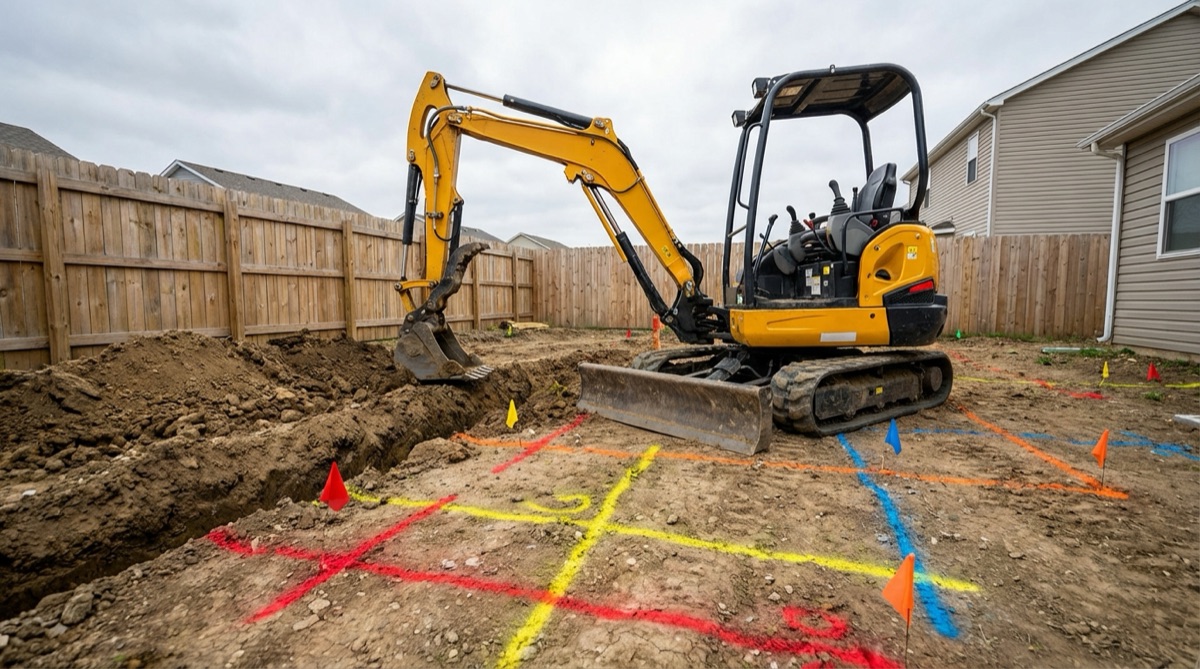
OSHA doesn’t require a specific license for excavator operation, but 29 CFR 1926.21 requires employers to ensure operators are competent and properly trained for the equipment they’ll use. If you’re hiring an operator, verify their experience and training documentation before they touch the machine.
Before you dig, call 811 at least 48-72 hours in advance. It’s free, legally required in most states, and skipping it makes you liable for any utility damage. For more on underground utility safety and trenching best practices, see the trencher and auger rental guide.
Trenches 5 feet or deeper require a protective system per OSHA’s excavation standards. The trencher and auger guide covers protective system options (sloping, shoring, trench boxes) in detail.
Key safety practices:
- Never work under a suspended load or raised boom
- Keep bystanders and other workers outside the machine’s swing radius
- Check overhead clearances for power lines — OSHA 29 CFR 1926.1408 requires a minimum 10-foot approach distance for lines under 50kV
- Use a spotter when working near edges of trenches or excavations
- Wear your seatbelt. Rollover is a real risk on slopes and uneven ground
- Never allow anyone in a trench while the excavator bucket is overhead
For related safety requirements on compaction equipment often used alongside excavators, see the compaction equipment rental guide.
What Should You Know Before Renting an Excavator?
The right insurance, correct bucket selection, and thorough machine documentation are the three things that prevent surprise charges on rental returns.
Get the right insurance. Your general liability policy may not cover rented equipment. Ask about the rental company’s damage waiver options, and check with your insurance broker before you sign anything.
Confirm the bucket size. Rental excavators often come with a general-purpose bucket. If you need a narrow trenching bucket, a grading bucket, or a clean-up bucket, request it when you book, not when the machine shows up.
Ask about the rental clock. Some companies charge by calendar days, others by operating hours. Know which model your rental agreement uses so you can plan your work schedule accordingly.
Book early for peak season. Spring and summer are the busiest rental periods. Mini excavators in popular markets get booked out weeks ahead. Reserve as early as you can, especially for weekly or monthly rentals.
Understand diesel emissions requirements. Most rental excavators now run Tier 4 Final diesel engines, the EPA’s current emissions standard for nonroad diesel equipment. Machines above approximately 75 HP (56 kW) — typically compact excavators and larger — generally require Diesel Exhaust Fluid (DEF), a urea solution stored in a separate tank, though this varies by manufacturer and engine model. Running out of DEF triggers engine derate and eventual shutdown, so check the DEF level daily. Never interrupt an active DPF (diesel particulate filter) regeneration cycle; let it complete before shutting down the machine. All Tier 4 Final equipment requires ultra-low sulfur diesel (ULSD).
Document the machine’s condition. When the excavator arrives, photograph or video the tracks, hydraulic hoses, cab interior, and any existing scratches or dents. Do the same when it leaves. That documentation is your protection against being charged for damage that was already there.
Ready to Rent? Find Excavators Companies Near You
477 companies across 31 cities
Sources
About the Author
Founder
Ray Smith built EquipNearby to help contractors and project managers find independent equipment rental companies across the US East Coast.
Frequently Asked Questions
How much does it cost to rent an excavator?
Mini excavator rentals (1-6 ton) typically run $200-$350 per day, $800-$1,200 per week, or $2,000-$3,500 per month. Compact excavators (7-14 ton) range from $400-$650 per day. Standard excavators (15-30 ton) run $750-$1,200 per day. Rates vary significantly by region, season, and rental duration — weekly and monthly rates offer substantially better per-day pricing than daily rentals. Delivery adds $150-$500 each way depending on distance and machine size.
Do I need a license to operate an excavator?
There's no federal license requirement for excavator operation on private property. OSHA standard 29 CFR 1926.21 requires employers to ensure operators are trained and competent before operating construction equipment, including excavators. Some municipalities require separate permits for excavation work, and projects near public utilities typically require a locate request through 811 before digging. If you're working on a public project, your general contractor license or excavation permit may apply.
What size excavator do I need?
For residential landscaping, fence posts, or small trenches, a mini excavator (1-4 ton) with 7-10 feet of dig depth is usually enough. Foundation work, pool digging, and utility trenches typically call for a compact excavator (4-10 ton) with 12-16 feet of dig depth. Commercial demolition and large earthmoving projects need standard or large excavators (10-45+ ton) that dig 20 feet or deeper and move significantly more material per cycle.
Can I get an excavator delivered to my job site?
Most rental companies offer delivery and pickup for an additional fee, typically $150-$500 depending on distance and machine size. Mini excavators under 10,000 lbs can sometimes be transported on a flatbed trailer if you have the right tow vehicle and a trailer rated for the machine's weight. Compact and standard excavators require a lowboy trailer and commercial hauling. Large excavators over 30 tons may need wide-load permits and escort vehicles for road transport.
What should I check before accepting a rental excavator?
Walk around the machine and check for fluid leaks, damaged hydraulic hoses, worn tracks or tires, cracked glass, and proper operation of all controls. Test the boom, stick, and bucket movements through their full range. Verify the horn, backup alarm, and lights work. Check the hours meter and DEF fluid level (if equipped). Note any existing damage on the rental agreement and take photos so you aren't charged for pre-existing issues when the machine is returned.
How deep can a mini excavator dig?
Most mini excavators (1-6 ton) dig between 7 and 12 feet deep, depending on the specific model and boom configuration. A typical 3.5-ton mini excavator like the Kubota KX040 or Cat 303.5 reaches about 10-11 feet of dig depth. That's enough for residential foundations, pool excavation, and most utility trenches. If you need to go deeper than 12 feet, you'll need a compact excavator (7-14 ton class) or a standard excavator.
What attachments work with rental excavators?
Most rental excavators accept hydraulic attachments through a quick coupler system. Common attachments include hydraulic breakers (for concrete and rock demolition), augers (for drilling fence post and pier holes), grapples (for sorting debris and handling brush), thumbs (for grabbing irregular objects), and trenching buckets (narrower than standard digging buckets). Confirm with your rental company that the machine has the correct hydraulic flow rate and coupler type for the attachment you need — not all machines are plumbed the same way.
Excavators Rental Companies by State
Browse 477 companies across 26 states.
Where to Find Excavators Rentals
We list 477 companies renting excavators across 31 cities. Browse by city to find rental companies near you.
Related Rental Guides
Compaction Equipment Rental: Plates, Rollers & Soil Specs
$55–$750/day depending on type. Compare plate compactors, rammers & vibratory rollers with soil-type matching for granular vs cohesive fills.
Loader & Dozer Rental: Types, Costs & Sizing Guide
$280–$1,600/day depending on machine type. Compare wheel loaders, backhoes, bulldozers & motor graders with HP sizing & delivery requirements.
Skid Steer Rental: Sizes, Costs & Attachment Guide
$250–$575/day for skid steers; CTLs 10–20% more. Compare small, medium & large frame models with attachment compatibility & hydraulic flow specs.