Towable Boom Lift Rental: Models, Towing & Costs
$250–$700/day for towable boom lifts. Compare 35–56 ft JLG, Genie & Niftylift models with towing weight, hitch specs & OSHA harness rules.
By Ray Smith · Published March 25, 2026 · Last updated May 27, 2026

Find Aerial Lifts & Boom Lifts Rental Near You
472 companies across 33 cities
Quick Reference
This guide covers towable boom lift rentals: what they are, which models are available, what you’ll pay, and what you need to know before you tow one to a jobsite. It’s written for contractors, property managers, facility maintenance teams, and homeowners who need elevated access without the cost and logistics of a full flatbed delivery.
What Is a Towable Boom Lift?
A towable boom lift (also called a trailer-mounted boom lift or towable cherry picker) is a self-contained aerial work platform built onto a road-going trailer. These are telescopic boom lifts on a compact, lightweight chassis. You hitch one to a pickup truck, tow it to the site, deploy the outriggers, and you’re working at height. No delivery truck, no crane, no flatbed required. If you’ve searched for a “small boom lift rental,” this is the category you’re looking for.
That’s the core appeal: the machine travels with you. Unlike self-propelled boom lifts, which require transportation on a flatbed and add delivery and pickup fees to every rental, a towable lift is its own transport. That saves money and gives you flexibility on jobs where you’re moving between sites.
The tradeoff is that towable lifts don’t drive themselves around the site once deployed. You set up in one spot, do the work you can reach from there, retract, reposition, and set up again. For jobs that require frequent repositioning across a large, open site, a self-propelled machine is more practical.
For a broader overview of aerial lift options, including scissor lifts and self-propelled boom lifts, see the aerial lift rental guide.
Popular Towable Boom Lift Models
The table below covers commonly rented towable models from Niftylift, JLG, and Genie. Haulotte also makes towable boom lifts but specific specs aren’t included here as they haven’t been independently verified.
| Model | Working Height | Platform Height | Outreach | Capacity | Weight |
|---|---|---|---|---|---|
| JLG T350 | ~35 ft | ~29 ft | 20 ft | 500 lbs | 3,400 lbs |
| Genie TZ-34/20 | 40 ft | 34 ft | 18 ft 4 in | 500 lbs | 3,155 lbs |
| Niftylift TM34 | 40 ft 6 in | 34 ft | 16 ft 6 in | 440–500 lbs | 2,630 lbs |
| Niftylift TM34T | 40 ft | 33 ft 6 in | 20 ft | 440 lbs | 3,100 lbs |
| Niftylift TM40S | 46 ft 6 in | 40 ft | 33 ft | 500 lbs | 4,500 lbs |
| Niftylift TM42T | 48 ft 6 in | 42 ft | 25 ft | 500 lbs | 3,915 lbs |
| Genie TZ-50/30 | 55 ft 6 in | 49 ft 6 in | 29 ft 2 in | 500 lbs | 4,400 lbs |
| Niftylift TM50 | 56 ft | 49 ft 6 in | 28 ft 6 in | 440 lbs | 4,760–4,890 lbs |
| JLG T500J | 56 ft | 50 ft | 31 ft | 500 lbs | 4,800 lbs |
Specs from manufacturer product pages and Home Depot rental listings. Genie specs from manufacturer spec sheet.
A few things worth noting across this lineup:
Working height vs. platform height. Working height is platform height plus roughly 6 feet of standing reach. The Niftylift TM50, for example, has a 49 ft 6 in platform height and 56 ft working height. Use working height when matching the lift to your job.
Niftylift TM50 power options. The TM50 is available in mains electric, battery, petrol, diesel, and bi-energy configurations. Battery and bi-energy models are the right pick for indoor or low-emission environments. The TM50 also features a telescopic upper boom for more precise platform positioning.
The TM34 is the lightest option in the lineup. At 2,630 lbs, it’s towable behind most half-ton pickups and gives you 40 ft 6 in of working height, solid for residential work, tree service, and light commercial maintenance.
How Much Does It Cost to Rent a Towable Boom Lift?
Boom lift daily rental rates range from $250 to $700 nationally, according to BigRentz. Towable models sit toward the lower end of that range. Home Depot rents the JLG T350 starting around $300 for a 4-hour rental.
Pricing varies significantly by market, platform height, and rental duration. A longer rental (weekly or monthly) typically brings the per-day cost down considerably.
For the full pricing breakdown by height, duration, and city, see the boom lift rental costs guide. That guide covers the full national ranges, city-by-city data, and what fees aren’t included in the base rate.
Looking for aerial lift rental companies near you? Browse independent rental yards in your area through our aerial lift directory.
Towing Requirements
Most towable boom lifts require a Class III receiver hitch with a standard 2-inch ball coupler. The JLG T350 and T500J both use a 2-inch hitch, and Genie’s TZ series offers multiple hitch options including 2-inch ball, 2-5/16-inch ball, pintle ring, and clevis coupler.
Weight is the practical constraint. Here’s what the common models weigh:
- Niftylift TM34: 2,630 lbs (minimum)
- JLG T350: 3,400 lbs
- Genie TZ-34/20: 3,155 lbs
- Niftylift TM42T: 3,915 lbs
- Genie TZ-50/30: 4,400 lbs
- JLG T500J: 4,800 lbs
- Niftylift TM50: 4,760–4,890 lbs
A half-ton pickup truck or full-size SUV handles the lighter models without issue. The heavier 50-ft class lifts (T500J, TM50, TZ-50/30) are approaching the upper end of what a half-ton can tow, depending on the truck’s specific configuration. Check your vehicle’s tow rating. Not the truck class in general, but your actual vehicle’s rated capacity.
Do you need a CDL? No. Federal CDL requirements apply to combinations with a GCWR of 26,001 lbs or more, and only when the towed vehicle’s GVWR exceeds 10,000 lbs. Towable boom lifts max out around 4,900 lbs. A standard Class C driver’s license is sufficient.
Towing safety. Connect safety chains crossed under the tongue, attach the trailer’s brake lights via 4-pin or 7-pin connector, and verify lights are working before leaving the yard. If you’re picking up from a rental center, the staff will typically walk through connection.
If you’re new to towing equipment trailers, the trailer rental guide covers the basics.
Setting Up on Site
Once you’re on site, setup follows a consistent sequence across all towable models:
1. Position the machine. Drive to the work area and park. You won’t be repositioning easily once the outriggers are down, so take a moment to plan the setup location relative to the work.
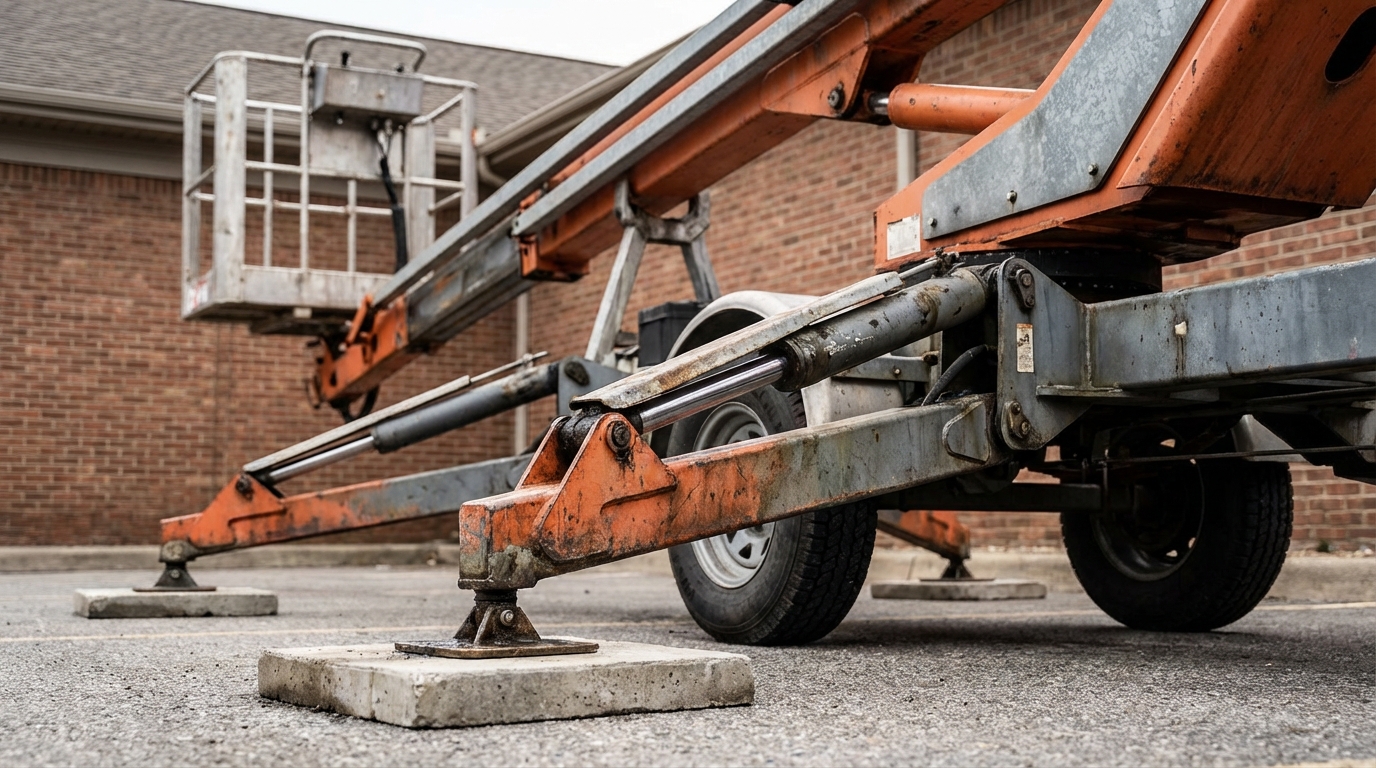
2. Set the brakes and deploy outriggers. OSHA 1926.453(b)(2)(vii) requires the brakes to be set before using an aerial lift. When outriggers are used, they must be positioned on pads or a solid surface. If you’re on an incline, wheel chocks are required before operation.
3. Level the machine. Most models have hydraulic self-leveling outriggers. The Niftylift TM50 uses hydraulic outriggers. Get the platform level before you start climbing. Unlevel setups put stress on the boom and increase tip-over risk.
4. Test the controls. 1926.453(b)(2)(i) requires lift controls to be tested each day prior to use. Test ground controls and platform controls before anyone goes up.
Ground conditions matter. Firm, dry ground is the standard. Soft soil, recently excavated areas, or ground near utility trenches can shift under load. If there’s any question about ground stability, use outrigger pads to distribute load over a larger surface area.
OSHA Safety Requirements
OSHA 29 CFR 1926.453 covers aerial lifts in construction. Three requirements are especially relevant to towable boom lifts:
Authorized operators only. Under 1926.453(b)(2)(ii), only authorized persons may operate an aerial lift. Authorization requires documented training. Renting the machine doesn’t automatically qualify anyone to operate it.
Fall protection. 1926.453(b)(2)(v) requires a body belt and lanyard attached to the boom or basket when working from an aerial lift. For lightweight towable lifts, many safety professionals recommend a fall restraint system (a short lanyard that prevents you from reaching the edge) rather than a full fall arrest system. The concern is that a long fall-arrest lanyard can generate enough force during a catch to destabilize a lightweight machine. A restraint-length lanyard keeps you inside the basket and avoids that risk.
Also note: the OSHA regulation’s own note specifies that as of January 1, 1998, body belts are not acceptable as part of a personal fall arrest system, but remain acceptable in fall restraint (tethering) systems under 1926.502(e).
No belting off to adjacent structures. 1926.453(b)(2)(iii) prohibits belting off to an adjacent pole, structure, or equipment while working from an aerial lift. Your lanyard attaches to the boom or basket. Never to a building, tree, or scaffold.
For comprehensive OSHA coverage including load limits, inspection requirements, and training standards, see the boom lift safety guide.
Common Use Cases
Towable boom lifts (sometimes listed as towable cherry pickers in rental catalogs) show up on a wide range of jobs, anywhere you need 35–56 ft of reach and the ability to bring the machine yourself:
- Tree trimming and arborist work. Reach upper canopy without a ground crew or crane.
- Exterior painting. Multi-story facades, trim, dormers, and soffits.
- Sign and lighting repair. Parking lot lights, building signs, scoreboard maintenance.
- Building and facility maintenance. HVAC on rooftops, gutters, window washing, caulking.
- Church and school maintenance. Interior ceiling work (battery models), exterior repairs.
- Residential work. Roof inspections, gutter cleaning, holiday lighting on tall homes.
- Event setup. Hanging banners, lighting rigs, temporary rigging in outdoor venues.
The JLG T350 product listing specifically calls out tree care, sign and lighting repairs, facility maintenance, painting, HVAC, electrical, and residential maintenance including roof, gutter, and pressure washing — all jobs where you just need to get up to height and do the work.
Towable vs. Self-Propelled Boom Lifts
| Factor | Towable Boom Lift | Self-Propelled Boom Lift |
|---|---|---|
| Transport | Tow with pickup, no delivery fee | Flatbed delivery required |
| Weight | 2,600–4,900 lbs | Generally 10,000 lbs and up |
| Site mobility | Must retract and reposition manually | Drives itself around the site |
| Typical working height | 35–56 ft | 40 ft and up (to 185+ ft for large telescopic) |
| Typical cost | Lower end of boom lift range | Higher, plus delivery/pickup fees |
| Best for | Single-location tasks, multiple sites, light commercial/residential | Large jobsites requiring frequent repositioning |
| Terrain | Paved or firm level ground only | Rough terrain models available |
If your job involves working across a large site and you need to reposition the lift repeatedly throughout the day, a self-propelled machine will be more efficient. If you’re doing focused work in one area, or working at multiple separate locations, the towable wins on total cost.
For a detailed scissor lift vs. boom lift comparison, see the scissor lift vs. boom lift guide.
How to Choose the Right Towable Boom Lift
Match working height to the job. Working height = platform height + ~6 ft. For work up to 40 ft (single-story commercial, two-story residential), the TM34 or JLG T350 class covers you. For work in the 45–56 ft range, look at the TM42T, T500J, or TZ-50/30.
Check your tow vehicle’s capacity. Light 35-ft models (TM34 at 2,630 lbs, TZ-34/20 at 3,155 lbs) tow behind most half-tons without issue. Heavier 50-ft models (T500J at 4,800 lbs, TM50 at 4,760–4,890 lbs) need a capable tow vehicle. Verify your truck’s rated capacity, not just the class.
Choose the right power type for your site. Battery and bi-energy models for indoor or low-emission work. Petrol or diesel for full outdoor days. The Niftylift TM50 offers all five power configurations: mains, battery, petrol, diesel, and bi-energy. Check the power type on any model before you book if indoor or low-emission use is a factor.
Verify you have outrigger space. Before reserving, walk the work area. The JLG T500J needs a 23.5 ft outrigger footprint. Tight lots, soft ground, slopes, and nearby structures can all limit where you can safely set up. This is easier to solve before delivery than after.
Consider outreach, not just height. If you need to reach over an obstacle (a parapet wall, a roofline, a piece of equipment), check the horizontal outreach spec. The Niftylift TM40S, for example, has 33 ft of outreach compared to the TM34’s 16 ft 6 in — almost double — which opens up very different positioning options at similar heights.
Ready to find a towable boom lift near you? Browse independent equipment rental companies in your area through the aerial lift directory. Local yards you can call directly, without platform markups.
Ready to Rent? Find Aerial Lifts & Boom Lifts Companies Near You
472 companies across 33 cities
Sources
About the Author
Founder
Ray Smith built EquipNearby to help contractors and project managers find independent equipment rental companies across the US East Coast.
Frequently Asked Questions
Do I need a CDL to tow a boom lift?
No. Federal CDL requirements kick in at a combined gross vehicle weight rating (GCWR) of 26,001 lbs or more, and only when the towed vehicle's GVWR exceeds 10,000 lbs. Towable boom lifts typically weigh between 2,600 and 4,900 lbs — well below that threshold. A standard Class C driver's license is sufficient for most towable boom lift rentals.
What vehicle do I need to tow a boom lift?
Most towable boom lifts require a Class III receiver hitch with a standard 2-inch ball coupler. The JLG T350 weighs 3,400 lbs and the T500J weighs 4,800 lbs — both within range of a half-ton pickup truck or full-size SUV with the proper hitch rating. Always confirm your vehicle's tow rating against the lift's towing weight before renting.
How much does it cost to rent a towable boom lift?
Boom lift daily rental rates range from $250 to $700 nationally, according to BigRentz. Home Depot rents the JLG T350 starting around $300 for a 4-hour rental. Towable lifts tend to sit at the lower end of that range because they're smaller and lighter than self-propelled models. For a full breakdown by height and city, see the boom lift rental costs guide.
Can I use a towable boom lift indoors?
Battery-powered and electric models can be used indoors — they produce zero emissions and run quietly. Gas and diesel models generate exhaust and should not be used in enclosed spaces. Niftylift's TM series is available in battery and bi-energy configurations for exactly this reason. Check the power type before you rent if indoor use is part of the job.
Where can I rent a towable boom lift near me?
Home Depot rents the JLG T350 and T500J at over 1,100 locations, and national platforms like Sunbelt Rentals and United Rentals carry towable models at most branches. For independent rental yards with competitive pricing, EquipNearby's aerial lift directory lets you search by location and contact local companies directly. Availability varies by market, so call ahead to confirm they stock towable models specifically.
What's the difference between a towable boom lift and a self-propelled boom lift?
A towable boom lift hitches to your vehicle and you tow it to the site — it doesn't move under its own power once deployed. A self-propelled boom lift drives itself around the jobsite and typically requires flatbed delivery. Towable lifts are lighter, cheaper to rent, and eliminate delivery fees, but they can't reposition themselves while elevated. For jobs that require frequent repositioning across a large site, a self-propelled machine is a better fit.
Do I need fall protection on a towable boom lift?
Yes. OSHA 1926.453(b)(2)(v) requires a body belt and lanyard attached to the boom or basket when working from an aerial lift. On lightweight towable lifts, a fall restraint system — a short lanyard that prevents you from reaching the edge — is generally recommended over a full fall arrest system, because a long fall-arrest lanyard generates enough force to tip a lightweight machine. Never belt off to an adjacent structure or pole, which is prohibited under 1926.453(b)(2)(iii).
Aerial Lifts & Boom Lifts Rental Companies by State
Browse 472 companies across 27 states.
Where to Find Aerial Lifts & Boom Lifts Rentals
We list 472 companies renting aerial lifts & boom lifts across 33 cities. Browse by city to find rental companies near you.
Related Rental Guides
Aerial Lift Rental Guide: Scissor Lifts, Boom Lifts & OSHA
$100–$700/day depending on lift type. Compare scissor lifts, boom lifts & telehandlers with delivery, OSHA training, and reach height guidance.
Boom Lift Rental Cost: Pricing by Height & Duration
$250–$700/day for a boom lift. Compare 34-ft to 185-ft articulating & telescopic models with weekly, monthly, and total landed cost guidance.
Boom Lift Safety: OSHA Regs, Training & Penalties
Up to $165,514/violation for willful OSHA boom lift violations. Covers 1926.453 vs 1910.67, harness rules, power line clearance & training requirements.
Trailer Rental: Flatbed, Dump, Enclosed & Lowboy Guide
$55–$650/day depending on trailer type. Compare flatbed, dump, enclosed & lowboy trailers with GVWR, payload, CDL thresholds & hitch matching.
Scissor Lift vs Boom Lift: Cost, Height & OSHA Rules
Scissor lifts start at $97/day; boom lifts at $242/day. Side-by-side comparison of reach, fall protection rules, platform capacity & use cases.